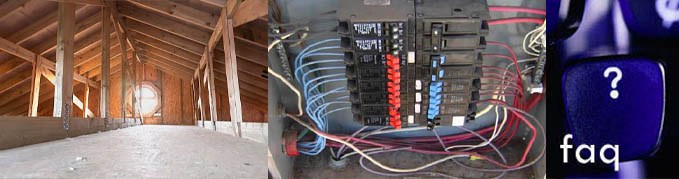
What exactly is a Home
Inspection?
A standard home inspection
is a visual examination of the physical structure and major interior systems
of a residential building, much like a physical exam that your doctor may
perform on you. However, it should be clearly understood that a home inspection
is not to be confused with an appraisal, warranty evaluation, building
code inspection, a guarantee of any kind, and/or an insurance policy on
the condition of the property.
What does a standard Home
Inspection Include?
During an inspection, the
inspector will review the readily accessible exposed portions of the structure
of the home, including the roof, attic, walls, ceilings, floors, windows,
doors, basement and foundation, as well as the heating/air conditioning
systems, interior plumbing and electrical systems for potential problems.
Keep in mind that a home
inspection is not intended to point out every small problem or invisible/latent
defect in a home. Most minor or cosmetic flaws, for example, should be
apparent to the buyer without the aid of a professional.
Why is a Home Inspection
so important?
The purchase of a home is
one the largest single investments you will ever make. With that in mind,
it is extremely important that you learn as much as you can about the condition
of the property and the possible need for any major repairs before making
the purchase. A home inspection by a LSBHI-licensed inspector helps minimize
the possibility of unpleasant surprises, unexpected costs and post-purchase
headaches.
It's important to remember
that a reputable home inspector will also point out the positive aspects
of a home, as well as the maintenance that will be necessary to keep it
in good shape. After the inspection, you will have a much clearer understanding
of the property you are about to purchase, giving you confidence and peace
of mind
What's more, home inspections
are not just for new homebuyers. For existing homeowners, an inspection
may be considered in order to identify problems in the making, and to learn
important preventive measures to avoid costly future repairs. If you are
planning to sell your home, you also may wish to have an inspection prior
to placing your home on the market. This will give you a better understanding
of conditions which may be discovered by the buyer's inspector, and an
opportunity to make repairs that will put the house in better selling condition.
How much does a Home Inspection
typically cost?
The fee for a typical one-family
house varies geographically, much like the cost of the property itself.
Other cost factors include the size and features of the house, its age,
and additional considerations such as optional testing.
When comparing inspection
services, it's important to remember that the lowest-priced inspector is
not necessarily the best choice. The inspector's qualifications, including
his experience, training, professional affiliations – and most importantly
his LSBHI licensing - should be the most important consideration when making
your decision.
Can't I Inspect the home
myself?
Technically, yes – but you're
taking a substantial gamble in doing so. Typically, even the "handiest"
homeowner lacks the knowledge, training and experience of a professional
home inspector, who has inspected hundreds, perhaps thousands, of homes
over the span of a career. An LSBHI-licensed inspector is familiar with
the countless elements of home construction, proper component installation,
and maintenance. They understand how the home's systems and components
are intended to function together, as well as how - and why - they fail.
What's more, most buyers
find it very difficult to remain completely objective and unemotional about
the house they really want, and this may skew their judgment. For the most
objective and accurate assessment of any home's condition, it is best to
obtain an impartial, third-party opinion by a trained, licensed expert.
Can a Home actually "fail"
an inspection?
Realistically speaking, no.
An inspection is merely a thorough examination of the home's current condition.
It is neither an appraisal (which determines market value) nor a municipal
inspection, which verifies local code compliance. A home inspector, therefore,
will not "pass" or "fail" a house, but will accurately and objectively
describe its physical condition and indicate potential problems or concerns.
When is the proper time
to order an inspection?
A home inspector is typically
contacted right after the contract or purchase agreement with the seller
has been signed, and, depending on the home inspector's schedule, is often
available within a day or two. However, before you sign any agreements
with the seller, be sure that there is an inspection clause in the contract,
making your purchase obligation contingent upon the findings of a professional
home inspection. This clause should specify the terms to which both the
buyer and seller are obligated.
Do I have to be
present for the home inspection?
Technically, no, but
LSBHI highly recommends that you attend, for several reasons:
1) You will be able
to observe the inspector and ask questions directly
2) You will learn,
first-hand, about the condition of the home and become familiar with all
its features and components
3) You will get to
know how various systems work, and how to maintain them.
If for any reason you cannot
attend the inspection, you can still rest easy knowing that your LSBHI-licensed
home inspector will provide you with a comprehensive, written report describing
the inspection and its findings. However, there's simply no substitute
for actually being there while the inspection takes place. Make time to
be there!
What if my inspector finds
problems with the home?
First of all, it's important
to remember that virtually no home is perfect. If your inspector does identify
some problems with the home, it doesn't necessarily mean you shouldn't
buy the house, only that you will know in advance what to expect.
What's more, you may be able
to negotiate the purchase price of the home with the seller if significant
problems are found, which will help you offset the required repair costs.
If the house checks out
OK, did I really need an inspection in the first place?
Most certainly, yes. Now
that your new home has been thoroughly inspected, you can complete your
home purchase with confidence in its overall condition and its vital systems
and components. You will also have become knowledgeable about your new
home's structure and systems, and can keep that information handy for future
reference.
What's The Difference
between a Home Inspection and Home Warranty Evaluation?
Some inspectors -- whether
hired through real estate agents or the homebuyers themselves -- don't
really perform a complete home inspection at all, but rather what's known
as a "warranty evaluation," and the difference is significant.
In a nutshell, a warranty
evaluation usually takes under an hour, only covers basic elements that
are covered by the home warranty such as the heating/air conditioning system
and other built-in mechanical systems. Whereas a real home inspection consists
of a full comprehensive evaluation of virtually every system and component
of the home, including major appliances, roof, structure and utility systems,
and includes a complete, written inspection report.
A licensed home inspector
is also required to carry a minimum of $300,000 in Errors & Omission
(E&O) Insurance, which protects both client and real estate agent in
case the inspector inadvertently misses or omits a major defective system
or component from his inspection report.
Recently, the Louisiana House
of Representatives passed H.B. 176, which clearly defines what a home inspection
entails. A complete copy of the bill is available at http://www.legis.state.la.us/leg_docs/03RS/CVT3/OUT/0000KORI.PDF
.
In addition, Act 568, located
at http://www.legis.state.la.us/leg_docs/03RS/CVT2/OUT/H0007610.PDF states
that these revisions officially went into effect on August 15, 2003.
|